

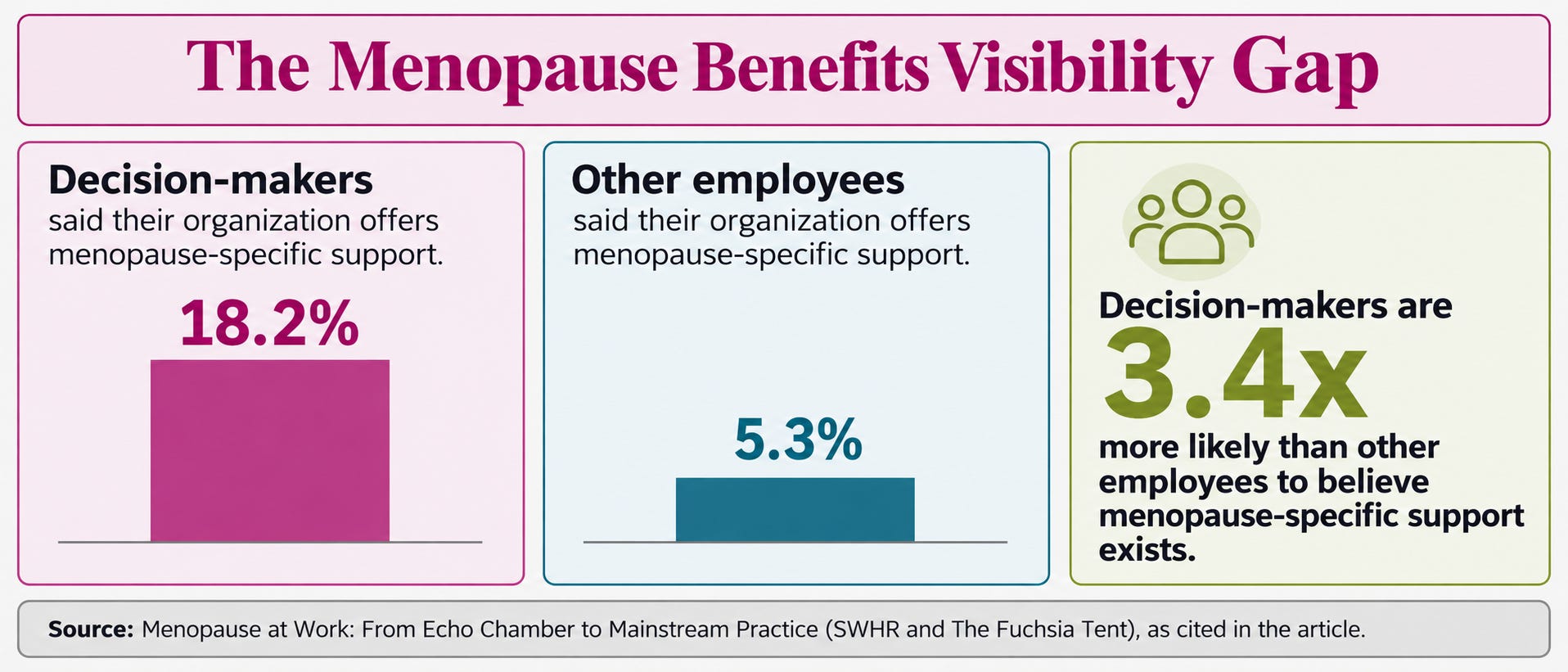
Menopause benefits look different depending on where you sit. A nurse on the night shift and the executive who approved her health plan may share the same coverage, but the executive is far more likely to believe it includes menopause support. In a new national study, 18.2% of decision-makers said their organization offers menopause-specific support, compared with 5.3% of other employees.
The study, Menopause at Work: From Echo Chamber to Mainstream Practice, from the Society for Women’s Health Research (SWHR) and The Fuchsia Tent, surveyed 1,110 employees and held roundtables in four cities between March and May 2026. Its central finding is that most of what employees want already sits inside benefits employers pay for. Algorithms aren’t the only systems deciding who sees women’s health information. The org chart does, too.
Menopause Benefits Get Lost As They Move Down The Org Chart
Decision-makers are about 3.4 times more likely than other employees to believe their organization offers menopause-specific support, the study found. But uncertainty runs through every level: 43.8% of non-decision-makers can’t say whether their employer offers menopause support, and neither can 29.0% of decision-makers.
Kacy Fleming, CEO of The Fuchsia Tent and co-principal investigator of the study, drew on her years running global well-being at Takeda Pharmaceuticals to explain the pattern. “Modern work structures add layers of management and that turns communication into a game of telephone,” she told me. Office staff, field sales, retail and manufacturing workers each receive information through different channels, and the further someone sits from the people making benefits decisions, the less clear is the information that reaches them.
Deskless workers, roughly a quarter of respondents, feel this most. In the roundtables, frontline workers described a menopause conversation that rarely reaches jobs shaped by locker rooms, uniforms, and fixed bathroom breaks. A desk-based woman in her 50s captured the underlying problem in her survey response, “To get any accommodations, one must know what to ask for.”
Vendors Add Another Filter Between Workers And Benefits
Third-party menopause vendors are usually pitched as the fix for this gap. Fleming points out that they can also widen it. “Third-party vendors add another layer of gating and complexity to making employees aware of what exists,” she explained.
Anyone who has watched platforms suppress women’s health content will recognize the pattern. Each layer filters, and the people with the greatest need sit behind the most filters. Inside a company, the filter isn’t an algorithm, but the outcome looks much the same.
What Workers Want From Menopause Benefits Is Already Paid For
The study asked women which workplace menopause support they would use, and 93% chose at least one. The top four were flexible scheduling or remote options (73.7%), coverage for menopause prescriptions (67.3%), confidential telehealth or virtual care (61.6%), and workplace adjustments such as temperature and dress (60.4%). According to the report, all four are tied to benefits and practices most employers already pay for.
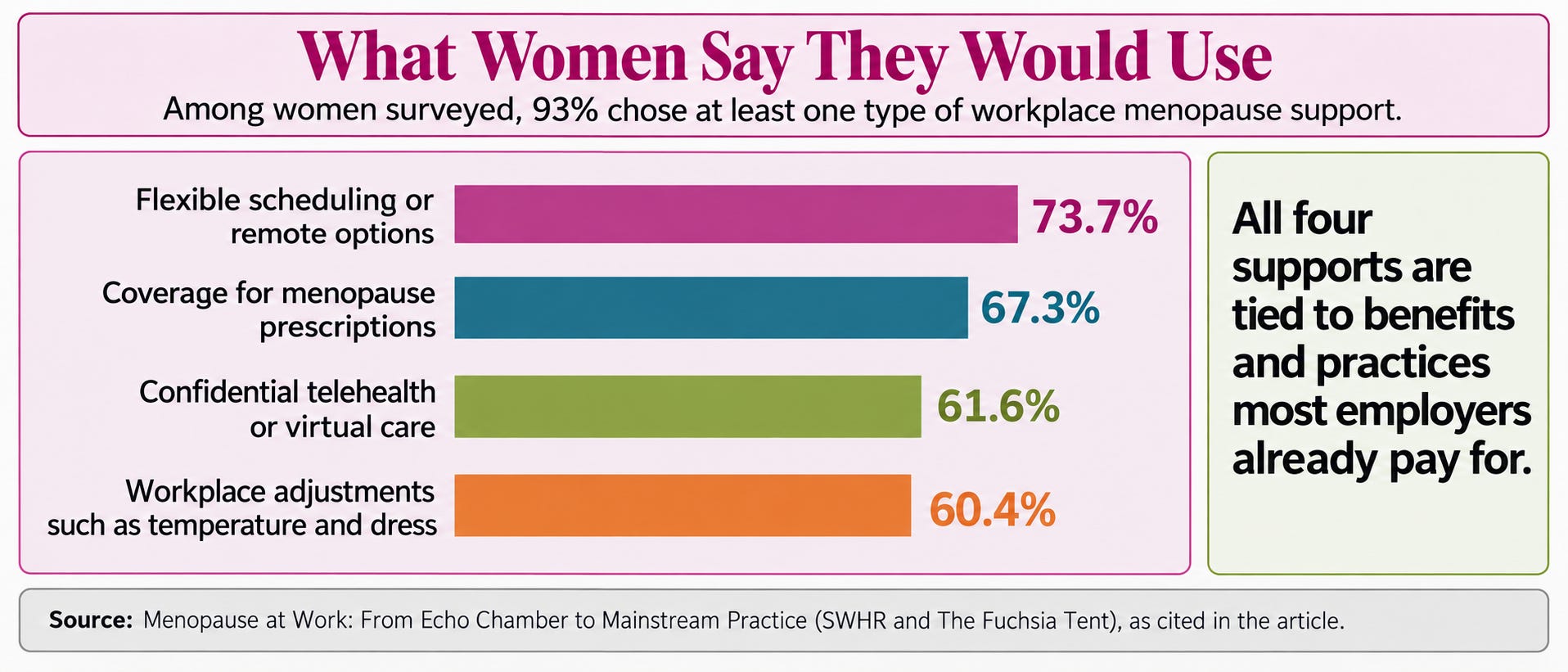
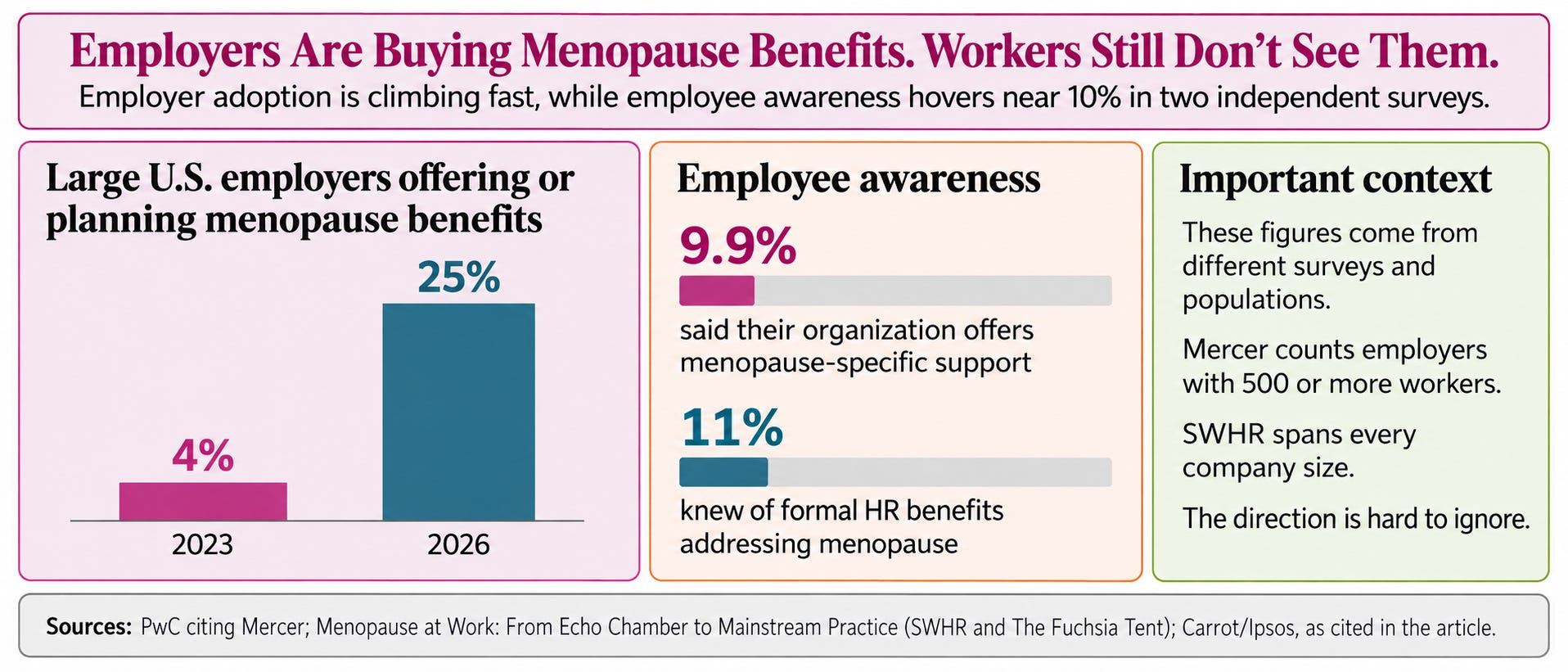
Employer-sponsored insurance is the most common type of health coverage in the U.S., covering 53.5% of Americans for some or all of 2025, according to the U.S. Census Bureau. Between 50% and 73% of employees reported that their employer offers benefits that can help with menopause symptoms, from medical and prescription drug coverage to specialist referrals and flexible scheduling. Yet, only 9.9% said their organization offers menopause-specific support. “The benefits are there, but employees don’t know it,” observes Syreen Goulmamine, co-principal investigator and associate director of research translation and programs at SWHR.
Independent data points the same way. In a survey of 3,000 U.S. women aged 35 to 54 that supplement brand OLLY and benefits company Carrot commissioned from Ipsos, only 11% of working women knew of formal HR benefits addressing menopause. Carrot sells menopause benefits, yet its number lands within about a point of the SWHR finding.
Prescription coverage carries new weight this year. In February 2026, the FDA approved removing cardiovascular disease, breast cancer, and probable dementia from the boxed warning on six menopausal hormone therapy products.
Goulmamine is careful about what the numbers can and can’t show. The study measured perception rather than benefit records, so either support exists and isn’t reaching employees, or leaders believe it is in place when it isn’t. “Either way, the employee ends up in the same place: managing symptoms without help,” she stresses.
The Menopause Market Counts Purchases, Not Whether Workers Use Them
Money is pouring into the category. PwC estimates menopause is a $10 billion to $15 billion global market, and that about $1.7 billion in private investment flowed into it between 2020 and 2025. Citing Mercer, PwC reports that 25% of large U.S. employers offer or plan to offer enhanced or standalone menopause benefits in 2026, up from 4% in 2023.
Set those numbers beside the workforce data and a mismatch appears. Employer adoption is climbing fast, while employee awareness hovers near 10% in two independent surveys. The populations differ, since Mercer counts employers with 500 or more workers and SWHR spans every company size, but the direction is hard to ignore. Of the 2,711 comments coded in the study, fewer than 20 mentioned buying a new tool.
Invisibility carries a price. Untreated menopause symptoms cost U.S. employers $26.6 billion a year in lost work time and medical spending, according to a Mayo Clinic study. In the SWHR research, one in three women with symptoms had considered leaving her job or cutting her hours.
Fleming argues that treating menopause as a standalone product creates its own friction. “Menopause care is part of women’s health care, not a siloed benefit; treating it as separate increases confusion and creates friction around access,” she notes.
Goulmamine adds that women need a clear path to FDA-approved treatments and to clinicians trained in menopause care. She offers founders and investors a test: “Any product that strengthens that path, reaches workers furthest from leadership, and measures whether people actually use it is building on what employees told us.”
What A Menopause Benefits Audit Looks Like
The report’s first recommendation is to audit existing benefits before buying anything new. Fleming frames a good audit around three questions:
Does the plan cover the full range of symptoms and needs, and can employees easily reach that support?
Does benefits information get to every type of worker, from the office to the plant floor?
Can employees get care without navigating a referral maze, prior authorization hurdles, or formulary restrictions?
The Fuchsia Tent advises employers on midlife support, so I asked Fleming how readers should weigh that advice coming from a consultancy. Employers should audit every benefit they pay for, she argues. “Whether they do that audit internally or externally is their choice, and it doesn’t change the advice.”
New Menopause Laws Depend On Workers Speaking Up First
Lawmakers are moving fast. Rhode Island became the first state to require workplace accommodations for menopause in 2025, and Philadelphia’s protections take effect January 1, 2027. Illinois Gov. JB Pritzker signed the Illinois Menopause Equity and Care Act on August 7, 2026, with employment protections starting January 1, 2027. In Congress, U.S. Reps. Debbie Dingell and Yvette Clarke introduced the Menopausal Workers’ Fairness Act on July 14, 2026.
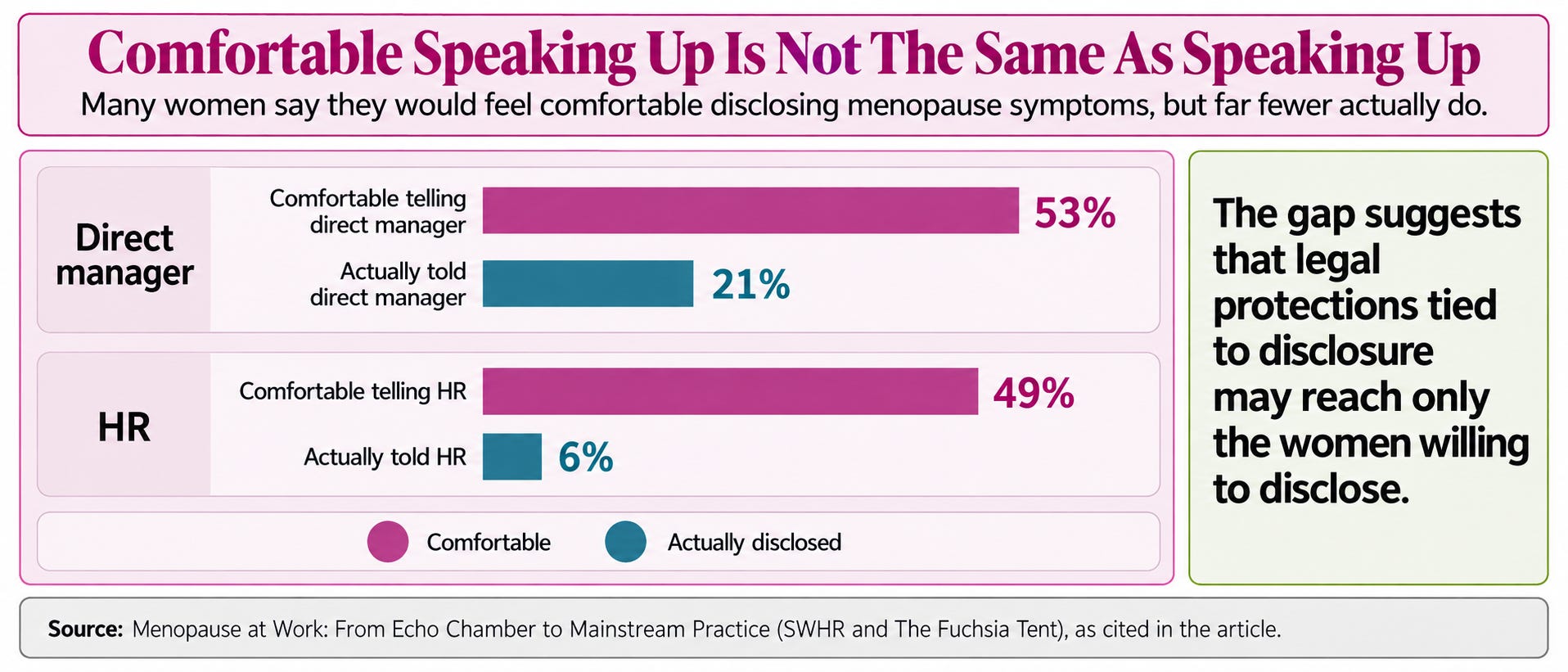
These protections largely rest on employees requesting accommodations. The study suggests few women ask. Among women with symptoms, 53% said they would be comfortable telling their direct manager, but only 21% had done so. With HR, 49% said they would be comfortable, yet only 6% had disclosed. In the roundtables, women explained that speaking up carries a cost to career progression.
That leaves employers and policymakers with an open question. A right that depends on disclosure may reach only the women willing to disclose. The report’s authors reach a blunt conclusion, “Reactive support will not work,” and urge managers to learn the basics of menopause symptoms rather than wait for employees to start the conversation.
Making Menopause Benefits Visible Is A Design Choice
Closing the gap doesn’t take the biggest budget. “The failures are connection and navigation, and those are the least expensive problems to fix,” Fleming contends. The report asks employers to put benefits information where deskless workers will see it, including break rooms, printed materials, and managers, and to measure utilization at least quarterly, reporting it the way any other benefit is reported.
Visibility is never neutral. Whether the system is a social media algorithm, a search engine, or a company org chart, someone designed its filters, which means someone can redesign them.
Goulmamine suggests where to begin: “Anyone building in this space should start by asking the workforce what they need.”
49% of symptomatic women said they'd be comfortable telling HR, and 6% did. That gap seems to matter as much as the 9.9% awareness figure, since a benefit people only get by disclosing will be used less.
Another strong article, Geri. Two things come to mind here: education and reimbursement.
Two years ago, I asked my gynecologist about HRT during my routine well-woman visit, and she offered me birth control instead. That experience prompted me to find a new doctor. My only option was a boutique-style clinic that didn’t accept my insurance. I paid out of pocket, and I continue to do so, for access to a doctor who is educated on menopause.
Hopefully, things have improved since then. There’s something worth examining when access to knowledgeable care requires paying out of pocket.