

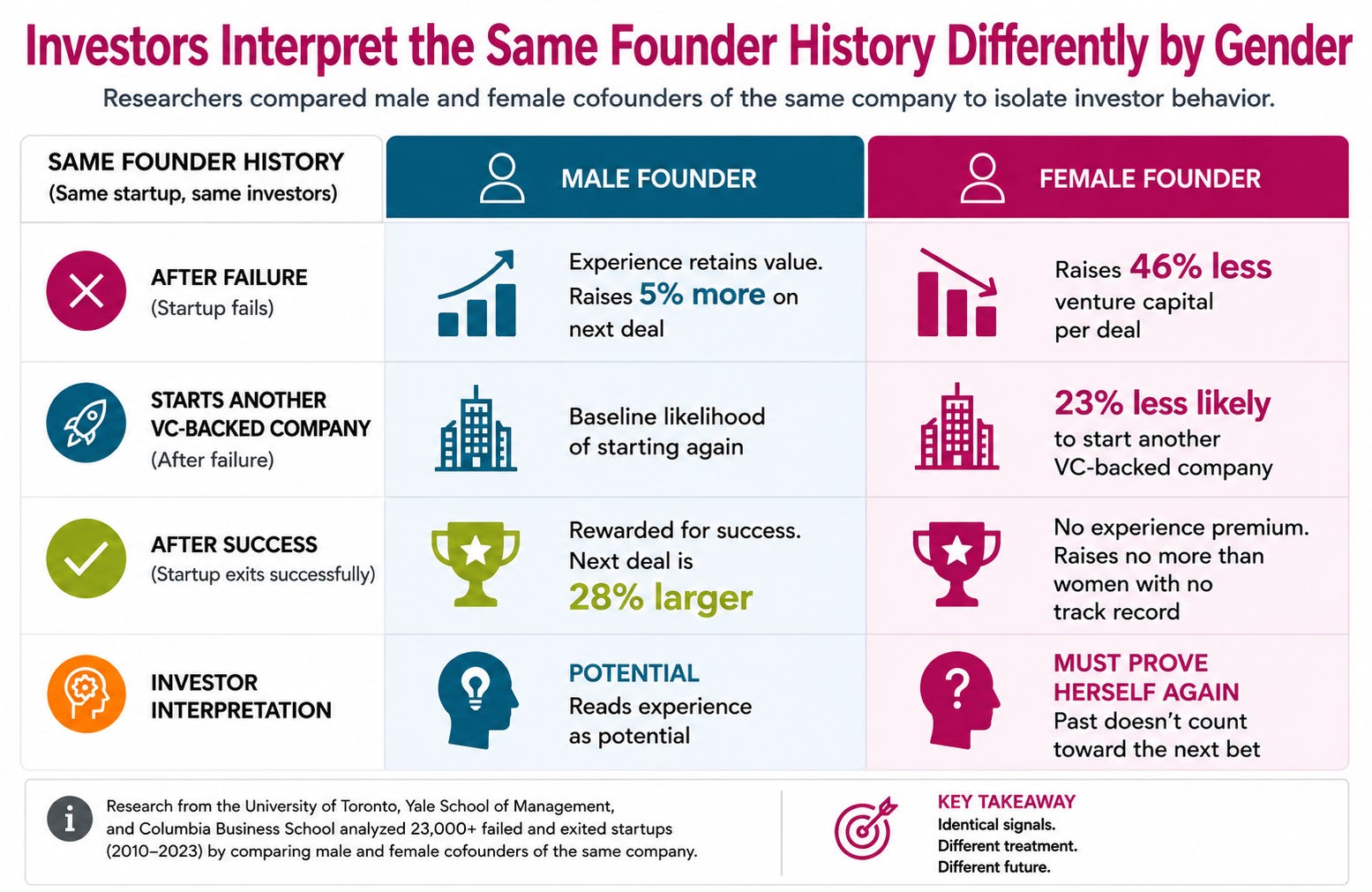
Two cofounders, a man and a woman, build the same startup. Same product, same investors, same failure. The man walks into his next pitch meeting with a clean slate and the possibility of getting everything he needs for his next deal. The woman will likely be penalized for that history and raise 46% less venture capital per deal.
Researchers at the University of Toronto, Yale School of Management, and Columbia Business School reached that finding by doing something no one had done before: comparing male and female cofounders of the same company. This method eliminates every excuse about pipeline, sector, or startup quality. After failure, women are 23% less likely than their male cofounders to found another venture-backed company. After success, 27% less likely.
The mechanism should sound familiar to anyone who follows how platforms treat women’s health content: The system remembers women’s failures and forgets their successes. Investors were running this algorithm long before AI existed.
Why Do Women Founders Raise Less Money After Failure
The study, Financing the Next VC-Backed Startup: The Role of Gender, tracked founders of more than 23,000 failed and exited startups from 2010 through 2023. Because cofounders generate an identical signal to the market, any difference in what happens next reflects how investors process that signal, not the startup itself.
The processing turns out to be one-directional. Experienced men get rewarded for any prior exit. A past success earns them deals roughly 28% larger. Even a past failure earns them 5% more, because investors read experience as potential. Experienced women with successful exits raise no more than women with no track record at all, and a single failure erases their entire experience premium.
Why Venture Capital’s Bias Never Corrects Itself
Interestingly, other research analyzing posts on a math Q&A platform found that women initially face discrimination but, after a sequence of positive evaluations, the direction of discrimination reverses. Apply that lens to VC markets, and you see a troubling, skewed pattern. Investors penalize women founders for failures but give them no credit for successes—an asymmetry inconsistent with rational updating and indicative of biased beliefs.
Joan C. Williams and Rachel Dempsey named this pattern more than a decade ago in What Works for Women at Work: Four Patterns Working Women Need to Know. Women are judged on performance, while men are judged on potential, and women must prove themselves again with every new role. The new research measures Prove-It-Again in dollars.
One Woman’s Failure Gets Billed To Every Woman
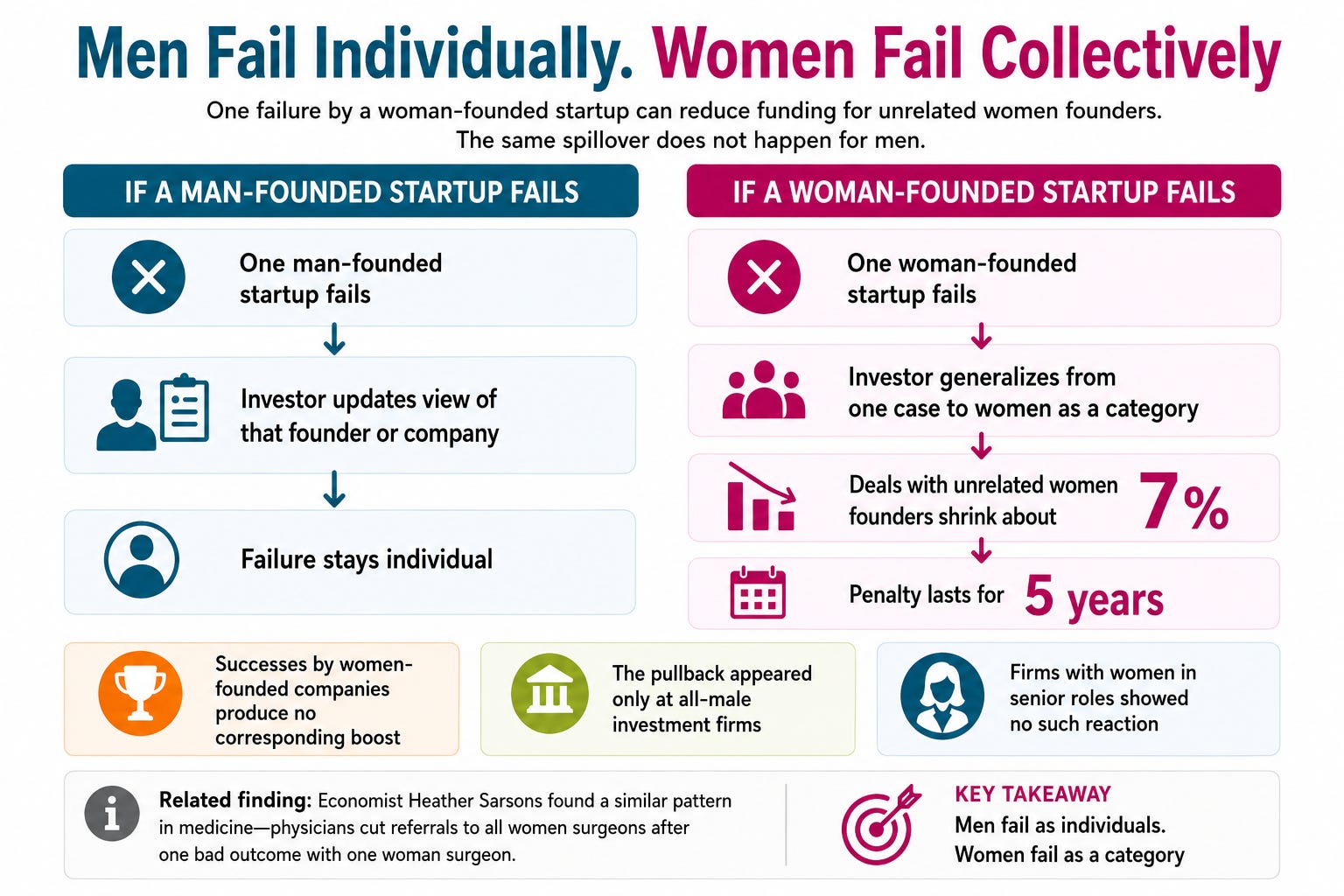
The finding that should alarm every woman raising capital right now involves founders she has never met. When an investor experiences a single failure by a woman-founded startup in their portfolio, their deals with unrelated women founders shrink about 7% over the following five years. Successes by women-founded companies produce no corresponding boost. None. And the pullback appears only at all-male investment firms. Teams with women in senior roles show no such reaction.
Economist Heather Sarsons documented the same reflex in medicine. Physicians cut referrals to all women surgeons after one bad outcome with one woman surgeon. No equivalent penalty spreads among men. Men fail as individuals. Women fail as a category.
Investors Were The First Biased Algorithm
Readers of this newsletter know the architecture. I have documented how moderation systems flag women’s health content that identical men’s health content sails past, and how LinkedIn’s 360Brew model suppresses posts that use clinical language about women’s bodies. Those systems share a signature: Negative signals get amplified, positive signals get discounted, and penalties generalize across an entire category of women.
The venture research reveals that this scoring function predates the software. A partnership evaluating a founder is an information system. It ingests signals, weighs them, and allocates the scarcest resource in entrepreneurship: a second chance. When that system charges a woman for her failure and gives her nothing for her success, it behaves exactly like a biased ranking model, except no one can audit it, and no one can file a trust-and-safety complaint.
Based on my research for this Substack, here’s what worries me most: The two layers likely feed each other. Suppressed content depresses audience growth. Depressed audience growth reads as weak traction. Weak traction becomes the negative signal that an already-biased investor overweighs. Each system launders the other’s output as objective data.
Why Women’s Health Is Underfunded Despite Strong Returns
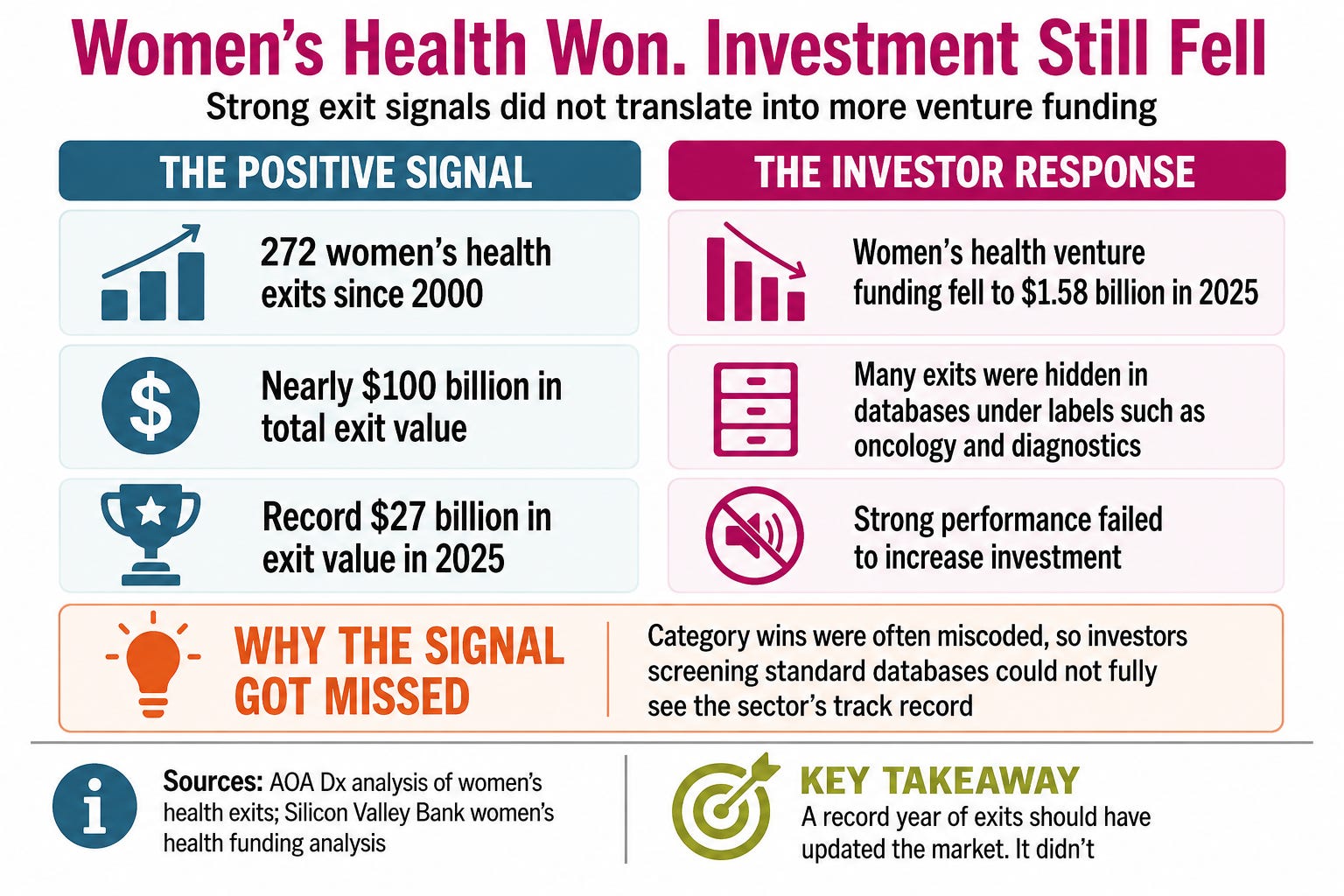
Now put women’s health founders inside that machine. A 2026 analysis, Follow the Exits: Why Women’s Health Is a Smart Bet in Healthcare from AOA Dx, examined 272 women’s health exits since 2000, worth nearly $100 billion. The analysis found that the category had been systematically miscategorized in databases such as PitchBook and Crunchbase under labels such as oncology and diagnostics. The sector’s wins were invisible to any investor running a standard screen.
Layer 2025 on top. Women’s health generated a record $27 billion in exit value, the strongest positive signal in the category’s history. That same year, Silicon Valley Bank reported that venture investment in women’s health fell to $1.58 billion from 2024’s all-time high, as healthtech funding dropped sharply and capital retreated toward oncology-focused biopharma.
A record year of wins arrived, and investment went down. Under rational updating, that cannot happen. The research explains why it did. Successes do not update the model.
Women’s health startups face double invisibility. Their category’s victories vanish into miscoded databases, and their founders’ individual victories vanish into investors’ one-way memory. Their failures, meanwhile, remain fully legible and fully charged, to themselves and to every woman behind them.
The Mispricing Hiding In Plain Sight
Here is the detail that turns this from an equity story into a market failure. The women who do get funded outperform their peers. Their subsequent ventures post higher value multiples than their male cofounders’ companies, and, after a prior success, their deals are more than twice as likely to return three times invested capital. While male investors are less likely to fund women-led firms, those who do see female-founded portfolio companies outperform those founded by men.
Investors are not screening out weak founders. They are systematically underpricing strong ones.
Williams and Dempsey observed that women are endlessly told the fault is theirs: pitch better, network harder, negotiate more. The evidence now points elsewhere. The founders are fine. The memory is broken. Whoever fixes it first—in the databases, the platforms, or the partnership meeting—gets to buy undervalued companies that everyone else refuses to see.
Could not have captured this better! Brilliant Geri.
I would add that the media engine has a lot to do with this problem—when a female CEO fails, it's front page for weeks. When a male CEO fails, it's below the fold—and he gets funded again, sometimes in bigger ways, just months later, often by the same VCs. (e.g., Newman and Kalanick)
Also, mini-plug for The Capital Flex, where anyone can listen in to hear these fundraising experiences firsthand - the differences are 100% real!
https://thecapitalflexpodcast.buzzsprout.com/
The cofounder-matched method is what makes this impossible to argue away. Same company, same failure, and only one of them gets to file it under experience. The part that compounds: a 46% haircut on the second raise follows her through every round after it, so one failure keeps getting charged for a decade.