

Six breast surgeons and radiation oncologists said yes. One said no.
The question before them was whether enough clinical evidence existed to support using biomarker tests to help determine which women with ductal carcinoma in situ (DCIS) could forgo radiation. The exchange took place during a 2024 Contractor Advisory Committee meeting convened by the Molecular Diagnostic Services Program (MolDX), which develops coverage policies used by several Medicare contractors. The panel was advisory, not binding.
A year later, MolDX proposed not covering the category.
That disagreement exposes a question with consequences far beyond one breast cancer test: Who decides when scientific evidence becomes good enough for reimbursement?
The Argument Is About What Kind Of Evidence Counts
MolDX is not arguing that no evidence exists for DCIS biomarker testing. The company has 57 publications and abstracts and has shared all 10 published manuscripts with MolDX. Even with all this clinical evidence, MolDX proposed noncoverage for tests intended to stratify recurrence risk and predict radiation benefit in DCIS.
Its objection is more specific. MolDX says current tests have not convincingly demonstrated enough improvement over clinicopathologic tools already available to physicians. Its review raises questions about direct comparisons with existing risk models, the populations studied, consistency among studies, and how different test thresholds were evaluated.
That distinction matters. If a new test costs money while a physician can use a nomogram or clinical criteria for free, asking the manufacturer to prove that the new information adds value is hardly unreasonable.
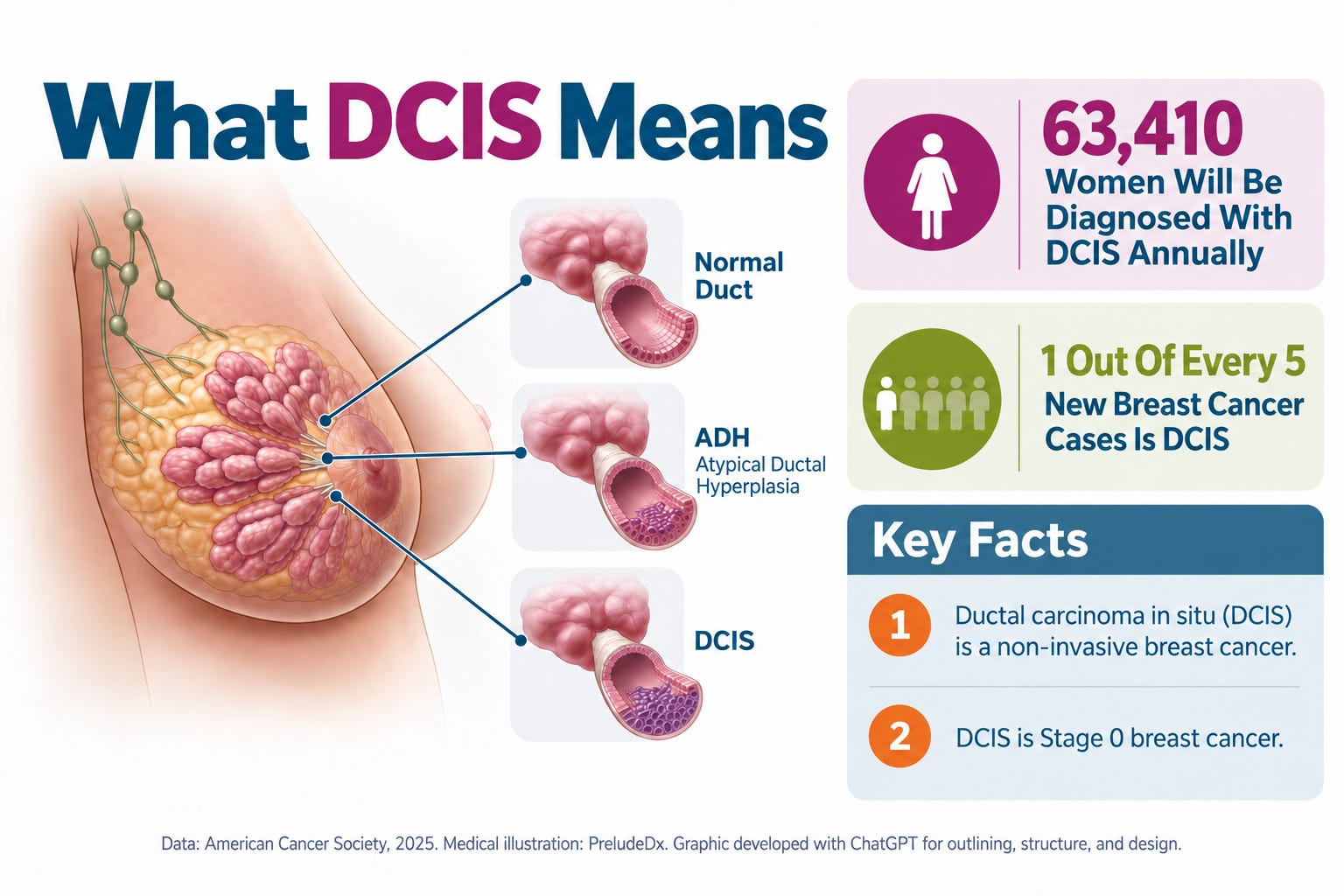
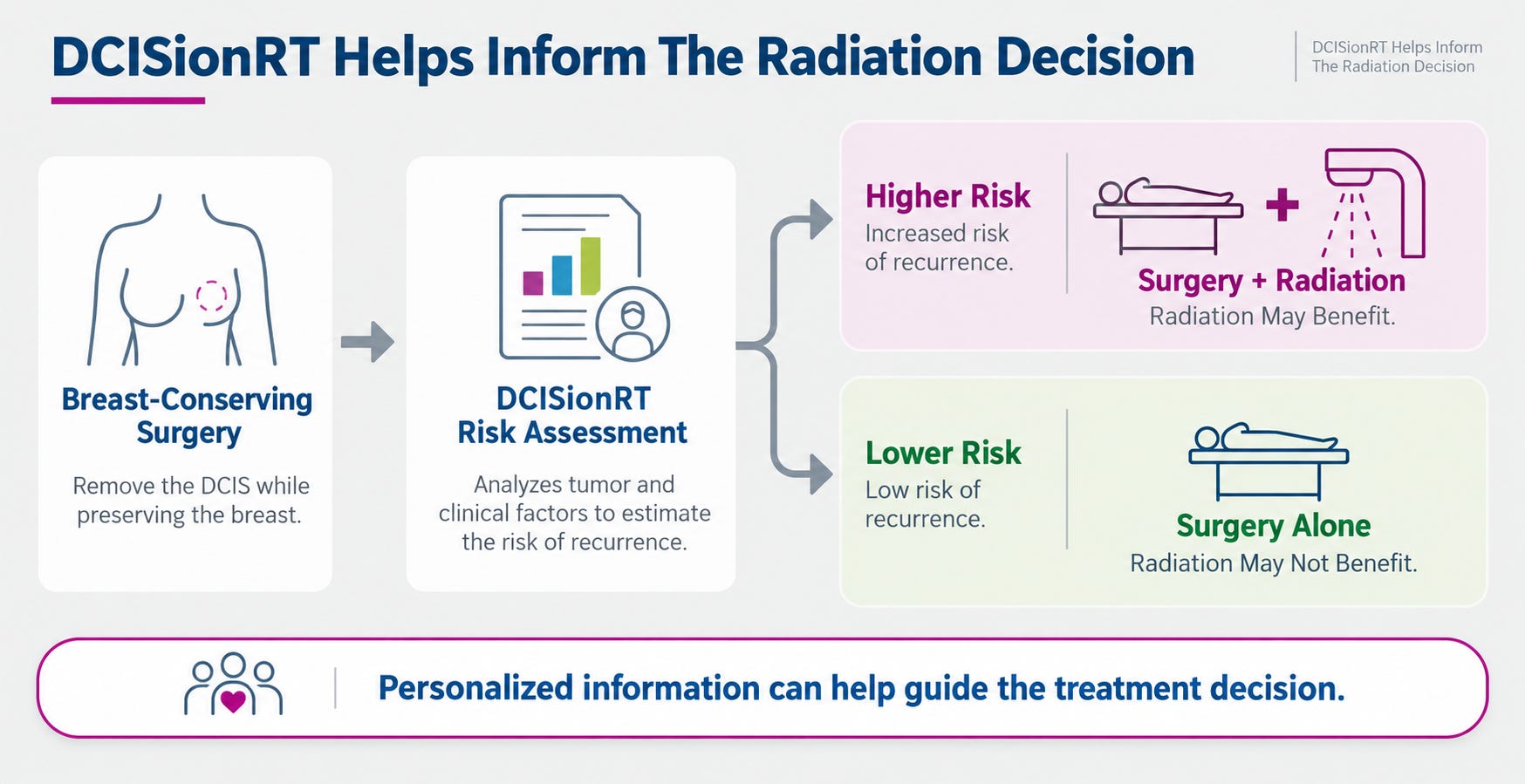
But clinicians supporting DCISionRT, the PreludeDx test at the center of the controversy, argue that this frames the problem incorrectly. Traditional tools infer risk from characteristics such as age, tumor size, grade, and surgical margins. DCISionRT incorporates tumor biology by measuring seven proteins along with clinical and pathological factors.
Dr. Patrick Borgen has seen both approaches. He was chief of breast surgery at Memorial Sloan Kettering Cancer Center while its DCIS nomogram was being developed.
“ClinPath features have failed us for 35 years with DCIS,” Borgen wrote in response to my questions.
The dispute, then, isn’t whether evidence should be required. It’s what the evidence must prove.
One Diagnostic Can Have Several Kinds Of Proof
That sounds like semantics until you look at the studies.
A 2024 study of 2,007 women at 63 sites examined what happened to physicians’ treatment recommendations after they received DCISionRT results. Radiation recommendations changed in 38% of cases. The changes went in both directions. Some women initially headed toward radiation were advised against it, while some initially considered unlikely to benefit were subsequently advised to have radiation.
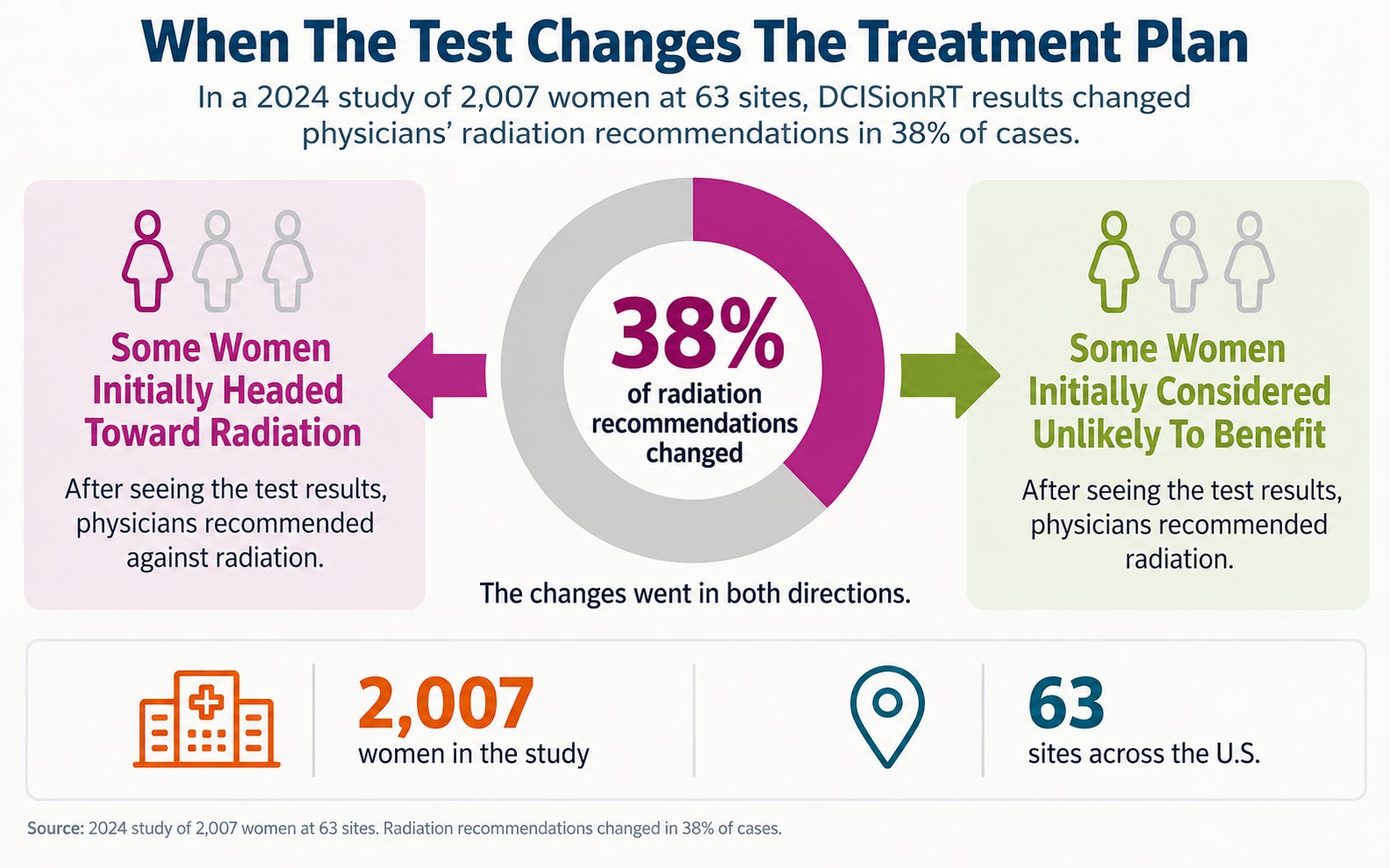
That establishes clinical utility. Doctors used the information and changed what they planned to do.
A different study used tumor samples from SweDCIS, a randomized Swedish trial in which women had been assigned to radiation or no radiation. That made it possible to examine a more difficult question: whether the test could distinguish women who benefited substantially from radiation from women who did not.
Here the details become important. At the prespecified Decision Score cutoff of 3.0, the statistical interaction for radiation benefit did not reach the conventional threshold for significance. An analysis using a cutoff above 2.8 did.
MolDX cited the threshold change as a concern. PreludeDx President and CEO Dan Forche disputes the characterization.
“We never changed. If you look at our report today, nothing ever changed in the report,” Forche emphasized. He said researchers evaluated 2.8 as an optimal point for radiation benefit but did not change the cutoff reported to patients.
A newer study tackled another MolDX objection by directly comparing the biosignature with conventional clinicopathologic risk classifications in 926 women. It found considerable disagreement over who was supposedly low risk and who was high risk, depending on which approach was used. The authors also acknowledged the limitations of observational evidence and pointed to randomized research as a higher level of evidence.
This is where a seemingly technical argument becomes a policy decision. Analytical validity, clinical validity, clinical utility, predictive ability, and superiority to an existing tool are not interchangeable standards. A payer ultimately decides which boxes must be checked before it pays the claim.
An Evidence Standard Becomes A Business Model
For a diagnostic company, that decision doesn’t sit neatly at the end of product development. It reaches backward into how the company must be financed.
A prospective outcomes study can take years and cost millions. Larger evidence bases require patients, clinicians, data, and capital. Yet investors assessing a diagnostic company also want to know whether payers will cover the test.
That creates a difficult loop: Evidence affects reimbursement, reimbursement affects adoption, adoption affects evidence generation, and all three affect financing.
PreludeDx’s experience illustrates the problem. The company says it submitted its technical assessment to MolDX in 2020. Six years later, the coverage question remains unresolved. Its test has been used clinically for years, but the parties still disagree over what constitutes sufficient evidence for coverage.
Forche described the problem in decidedly nonacademic terms: “Where’s the bar? You tell me, right? They keep moving the goalpost on us.”
That is the manufacturer’s view. MolDX plainly sees the evidence differently. But founders and investors don’t have to agree with Forche to recognize the underlying business risk.
A company needs to know not merely whether it can validate a diagnostic. It needs to know what evidence a payer will eventually require, whether that standard is knowable early enough to design the right studies, and who will finance the years between those two points.
That is particularly consequential in women’s health, where many innovations aim to do more than introduce another treatment. They want to distinguish which woman needs which intervention.
The Question Investors Should Ask Before Funding Diagnostics
The next chapter will begin October 13, when Medicare contractors convene another advisory panel on DCIS biomarker testing. Reconvening the experts after a draft coverage policy, public comment, and the first advisory discussion gives the new meeting unusual significance.
The important question isn’t whether that panel sides with PreludeDx. Evidence standards should be rigorous. A diagnostic that changes treatment recommendations should have to demonstrate that those changes improve decision-making, not merely that physicians respond to a test result.
The harder issue is whether innovators know the rules while they still have a chance to build the evidence those rules demand.
For health founders and their investors, that belongs in due diligence alongside market size, intellectual property and regulatory strategy: What precisely will a payer require before this innovation becomes coverable?
A diagnostic can make it through the laboratory, peer review, and clinical adoption and still encounter another definition of proof at the payment gate.
The scientists may demonstrate that a test works. The market still depends on someone deciding when the evidence is good enough.
Oh the moving milestones! It's not just unfair, it can change the way a study is designed and endpoints chosen to meet what you think is a target only to find it's gone elsewhere.
This is stupendous research and writing.
This stuck with me, in particular:
“…investors assessing a diagnostic company also want to know whether payers will cover the test. That creates a difficult loop: Evidence affects reimbursement, reimbursement affects adoption, adoption affects evidence generation, and all three affect financing.”
I read Halle Tecco’s article yesterday on Oura’s public filing. I see them as cracking this code by first going direct to consumer, then using consumer demand to back into clinical use of their wearable. I see that as the main option for bridging the financing gap these startups see, but curious if you agree or see other strategies in use.